Good Long Hair Fashions for Waitresses

A man with shoulder length hair, 1659
Long hair is a hairstyle where the head hair is allowed to grow to a considerable length. Exactly what constitutes long hair tin can change from culture to culture, or even inside cultures. For example, a woman with chin-length hair in some cultures may exist said to accept brusk hair, while a man with the same length of pilus in some of the same cultures would exist said to take long hair.
Males having short, cut hair are in many cultures viewed as beingness under society's control, such as while in the armed forces or prison or equally punishment for a crime. Long lustrous female hair is more often than not rated attractive by both men and women across cultures.[1] [two] The prevalence of trichophilia (hair partialism or fetishism) is 7% in the population, and very long hair is a common subject of devotion in this group.[3] [4]
Biological significance [edit]

Humans, horses, orangutans and lions are amidst the few species that may grow their head pilus or manes very long. Humans are believed to have lost their fur 2.five–3 million years ago every bit hominids when transitioning from a forest habitat to the open savanna, as an outcome of natural option, since this evolution fabricated it possible to run fast and hunt animals close to the equator without getting overheated. Caput pilus was an exception, which was a survival trait considering it provides thermal insulation of the scalp from the sun, protects against ultraviolet radiation exposure (UV), and besides provides cooling (when sweat evaporates from soaked hair).[v] The power to grow straight hair has been observed among Homo sapiens sub-groups in less sunny regions further away from the equator. Relative to kinked Afro-textured hair, straight hair allows more UV light to pass to the scalp (which is essential for the production of vitamin D, that is important for os evolution[half dozen]).
Scientists likewise view the ability to abound very long pilus equally a consequence of sexual option, since long and good for you hair is a sign of fertility and youth.[7] [ need quotation to verify ] An evolutionary biological science explanation for this attraction is that pilus length and quality tin can act as a cue to youth and health, signifying a woman's reproductive potential.[8] As hair grows slowly, long hair may reveal two–3 years of a person's wellness status, nutrition, age and reproductive fettle. Malnutrition, and deficiencies in minerals and vitamins due to starvation, cause loss of hair or changes in hair color (due east.g. nighttime hair turning reddish).[9]
Psychological significance [edit]
Anthropologists speculate that the functional significance of long caput hair may be adornment, a by-product of secondary natural option one time other androgenic/somatic hair (body hair) had largely been lost. Another possibility is that long head hair is a upshot of Fisherian runaway sexual selection, where long lustrous hair is a visible mark for a salubrious individual. For some groups or individuals, still, short hair is the selected trait.[7]
By 7 to 9 months, infants tin can tell the sexes apart based on hair length, vocal pitch, and faces.[10]
Cultural meaning [edit]
Ways of life often viewed equally more than rigid, such as soldiering and religious discipline, ofttimes have explicit rules regarding hair length. For instance, Buddhist monks shave their heads as part of their order of worship.[11] Similarly, religious men with long hair include the Nazarites of the Hebrew Bible (Samson being a well-known example)[12] and the Sikhs.[13] Other cultures may view male long pilus negatively; historically, some conquering groups take used the long hair of conquered people equally a symbol of their imagined "otherness" or inferiority, every bit was the case with the Gaelic Irish under English rule and the Moors under Castilian rule in Medieval Kingdom of spain.
East Asian cultures have traditionally associated unkempt hair in a woman with an irresponsible attitude, as women in Due east Asia were expected to tie up their hair in styles such equally the ponytail, plait, or any bun, as a symbol of responsibility.[14]
Transferred meaning [edit]
The traditional connotation of "long pilus" in English meant, roughly, someone artistically knowledgeable or wise, an aesthete.[15] As a descriptive term, it has been applied to Merovingians and classical music enthusiasts, equally well as hippies and aesthetes.[15]
Hair lengths [edit]
-

A Japanese woman with long hair
-

An Italian woman with long pilus
-

A Sri Lankan woman with long pilus
-

A Tibetan woman with very long hair
-

Manhattan woman with knee-length braided hair
-

An Indian woman with tied-upward long hair
Hair length is nearly frequently measured (in centimeters or inches) from the line of the scalp on the forehead upwards over the highest point of the skull to its termination, and sometimes from the crown, the latter resulting in 10 centimeter lower values in average.[16] In cosmetology, hair lengths are unremarkably categorized co-ordinate to the part of the body where the bulk of the longest hair terminates: mentum level, shoulder length, lower shoulderblade/mid-back level, waist length, hip-length, classic length (extends to almost buttock-length, i.e. upper thigh-length, where the legs meet the buttocks), thigh-length, knee-length and ankle/floor length hair.[xvi] [17]
Hair normally takes near 2 years to reach shoulder length,[xviii] and nearly seven years to reach waist-length/hip-length, including occasional trims (approximately lxxx–90 cm (31–35 in) from forehead for most people).[17] [18]
Maximum hair length [edit]
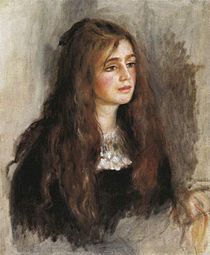
Portrait of Julie Manet by Renoir, 1894
The maximum hair length that is possible to reach is about fifteen centimetres (5.9 in) in for infants (beneath the age of 1), about 60 centimetres (24 in) for children, and generally 100 centimetres (39 in) for adults. Documentation for decrease of the maximum length with historic period cannot exist plant in the literature. Some individuals can reach excessive lengths. Lengths greater than 150 centimetres (59 in) are ofttimes observed in long hair contests.[19] Xie Qiuping had the longest documented hair in the world, measuring five.627 metres (18 ft 5.54 in) in May 2004.[twenty]
The maximum concluding hair length depends on the length of the anagen (catamenia of pilus growth) for the individual. Waist-length pilus or longer is only possible to attain for people with long anagen. The anagen lasts betwixt 2 and 7 years, for some individuals fifty-fifty longer, and is followed by shorter catagen (transition) and telogen (resting) periods. At any given time, about 85% of pilus strands are in anagen.[21] The fibroblast growth cistron 5 (FGF5) gene affects the hair bike in mammals including humans; blocking FGF5 in the human scalp (by applying a herbal extract that blocked FGF5) extends the hair cycle, resulting in less hair fall and increased hair growth.[22]
Cultural history [edit]
Europe [edit]
Ancient Hellenic republic and Rome [edit]

Roman marble jumbo head of a long-haired Zeus, second century Advert.
In aboriginal Greece, long male hair was a symbol of wealth and power, while a shaven caput was appropriate for a slave. The aboriginal Greeks had several gods and heroes who wore their pilus long, including Zeus, Achilles, Apollo, and Poseidon. Greek soldiers are said to have worn their hair long in boxing. Such warriors considered it a sign of elite and are said to have combed information technology openly to show off. Also, in club to keep enemies from getting agree of it in battle, they were known to cut the front brusque, only leave information technology long in the back, where it was more out of accomplish (mullet). A widely held alternative interpretation of the conventional belief is that they kept it long, and simply tied it back in a style known every bit a ponytail in social club to go on it out of their enemies' reach. The ponytail method allowed warriors, who often traveled to boxing with a minimal amount of equipment so that they could avoid excessively heavy loads over long marches, to go on their hair manageable with a small piece of string to hold it in identify and a pocketknife to cut the back to length with 1 piece. Around the 6th century, even so, the Greek men shifted to shorter hairstyles, with the exception of the Spartans. Women in the culture kept the longer style, which for them showed liberty, health, and wealth, as well every bit practiced beliefs.[23] With men, long hair by this time was considered a sign of false pride.[24]
Pliny the Elder in his Natural History and Varro related that the Romans did not brainstorm to cut their pilus brusk until barbers were introduced to Italy from Sicily by P. Ticinius Mena in 299 BC.[25] Women in Roman times valued long hair, usually with a center role. Autonomously from in the earliest times, men's hair was unremarkably shorter than women's, although other cultures of the time, such equally Greeks in the east, considered long hair to be typical of philosophers, who were thought to exist as well engrossed in learning to carp with pilus.[26] Strictly in the province of Rome, notwithstanding, the shorter hairstyle was especially popular.[24] When Julius Caesar conquered the Gauls, who favored long pilus, he ordered theirs to be cut brusque.[27]
Middle Ages [edit]
In the European middle ages, shorter hair often signified servitude and the peasantry, while long hair was ofttimes attributed to freemen, as was the case with the Germanic Goths and Merovingians.[ citation needed ]
The Gaelic Irish (both men and women)[28] took great pride in their long hair—for instance, a person could be heavily fined for cutting a man'southward hair short against his volition.[29] When the Anglo-Normans and the English colonized Republic of ireland, hair length came to signify one's fidelity. Irishmen who cutting their hair short were deemed to be forsaking their Irish heritage. Besides, English language colonists who wore their hair long in the back were deemed to be forsaking their part as English subjects and giving in to the Irish life. Thus, hair length was one of the nearly common means of judging a true Englishman in this menstruum. Muslims in Christian areas were ordered to keep their pilus short and parted, as their longer style was considered rebellious and barbaric.[30]

The long hair tradition was widespread among English and French men in the 11th and 12th centuries, although it was considered adequate for men to have shorter hair, mainly because of the endorsement of the Roman Catholic Church building. The tradition was largely brought about past monarchs who rejected the shorter hairstyle, causing the people to follow. Wulfstan, a religious leader, worried that those with longer hair would fight like women, and be unable to protect England from foreign invasion. Similar ideas can be found amid later military leaders every bit well, such as those of the American Confederacy.[31] Knights and rulers would also sometimes cut or pull out their hair in club to show penitence and mourning, and a squire's hair was generally worn shorter than a knight'south. Married women who let their pilus menses out in public were frowned upon, as this was normally reserved for the unwed, although they were allowed to let it out in mourning, to show their distressed country. Through these centuries information technology was expected of Eastern Christians to wear long hair as well every bit long beards, which was expected particularly of clergy and monks.
In England, during the English Civil Wars of 1642 to 1651, male hair length was emblematic of the disputes between Cavaliers and Roundheads (Puritans). Cavaliers wore longer hair, and were less religious-minded, being thought of by the Roundheads equally lecherous. The more devout Roundheads typically had somewhat shorter hair.[11]
Effectually this time, long hair in England also came to be associated with adventurers who traveled to America and were familiar with the native culture at that place, short hair was associated with less audacious types.
Trends amongst women in 20th and 21st centuries [edit]
-
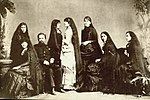
The Seven Sutherland Sisters were singing and showing off their famous flooring-length hair in a sideshow of Barnum & Bailey's from well-nigh 1882 to 1907.
-

Dutch woman with thigh-length hair
Growing and wearing long hair was mutual amid women in the Western world until World War One.[17] Long female hair never ceased in western civilisation, though it was rare during the 1920s and 1930s.
In virtually electric current cultures, it is more typical for women to article of clothing long hair than for men to do then. An American study shows significant correlation between hair length and age, which indicates that younger women tend to have longer pilus than older women. A significant correlation was also plant between women's pilus length and hair quality. Moreover, hair quality was correlated with the women's perceived physical wellness. Consistent with principles of evolutionary psychology, these results betoken that hair length and quality can human activity as a cue to a woman's youth and health, signifying reproductive potential. The correlation betwixt the woman'south pilus length and marital status, or number of children, was however not more than to be expected from the correlation between hair length and historic period.[eight]
Trends among men in 20th and 21st centuries [edit]
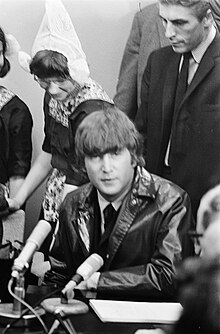
Long male hair in Western youth culture became popular in the 1960s and 70s with the Beatles.


During the 19th century male hair lengths in Western cultures had varied widely; according to nationality, occupation, age, social condition and passing manner. Even so, prior to Globe War Ane beards had largely been replaced by moustaches and pilus was most commonly cutting to a medium/short length. However, curt pilus on men was introduced in World War I for soldiers. Slaves and defeated armies were often required to shave their heads. The trench warfare engaged in from 1914 to 1918 exposed men to flea and lice infestations, which prompted orders past the higher control to cut pilus brusque, establishing a new military tradition.[17]
Beat poets during the 1950s wore longer hairstyles. By 1960, a pocket-sized "beatnik" community in Newquay, Cornwall, England (including a young Wizz Jones) had attracted the attending of their neighbors for growing their hair to a length past the shoulders, resulting in a television receiver interview with Alan Whicker on BBC boob tube's Tonight series.[32] The 1960s likewise introduced The Beatles, who started a more widespread longer hair tendency. The social revolution of the 1960s led to a renaissance of unchecked hair growth,[17] and long hair, especially on men, was worn as a political or countercultural symbol or protest and as a symbol of masculinity. This cultural symbol extended to several countries in the Americas, Western Europe, South Africa, and Australia.[33] The trend even spread to some Eastern Bloc countries, such as the Mánička subculture of Czechoslovakia, which was met with bigotry by the authorities, who saw it as unwanted Western capitalistic influence. Specific long hairstyles such as dreadlocks have been function of counterculture movements seeking to define other alternative cultures and lifestyles since this time.[fourteen] Longer hair in general remained popular due to the youth rebellion throughout the liberal decade of the 1960s. The long hair trend grew with the spread of the hippie movement in the 1960s[33] and, in the 1970s, longer hair styles would get the norm amidst men and women.
In the 1970s, the popularity of Jamaica's reggae music and musician Bob Marley prompted involvement in dreadlocks internationally. The anti-institution philosophy of Rastafari, echoed in much of the reggae of the time, resonated with left-leaning youth of all ethnicities – peculiarly and primarily amongst African Americans and other Blacks, but among counterculture Whites besides.[34] In the 1980s, the view of long hair as a lone signifier of political or counter-cultural identity was countered and parodied in films such as Rambo and many other militaristic heroes of media which challenged then-contemporary views of tradition.[35] In the 2000s, longer hairstyles amidst men became popular among neopagans and stone enthusiasts;[36] for instance, musicians in metal bands and their fans often wear long hair. Long hair may be grown for the purpose of its existence donated to an organization, such equally Locks of Love, that provides hairpieces to aid those who tin can not have pilus otherwise, such as those who are diagnosed with baldness areata. Today long pilus has gained even more popularity. Fifty-fifty among mainstream men information technology is socially adequate to have hair reaching effectually the upper back. This could in part be due to the "man bun" trend where men pull their shoulder length or longer pilus dorsum into a topknot bun.[ citation needed ]
Americas [edit]
Native Americans [edit]

Many Native American men wore long hair before the arrival of Western influences on their culture. (In Cherokee legends, for example, males said to exist handsome were ofttimes described equally having "long hair near to the ground" or similar formulas.[37]) Both men and women of these cultures have frequently struggled to maintain their tradition but take faced heavy opposition. Many consider it a sign of giving in to Western influences to have their hair cut.[38] [39] Early on Us settlers saw long-haired, native men equally rebelling confronting their civilized lodge. Mountain men and trappers who adopted the community were besides considered amoral, and frequently identified by their long hair.[40] Since the cultural movements of the Sixties and Seventies, however, Native Americans have felt less pressure to have brusque hair, every bit different movements have defended their cultural rights.[41] For example, several states accept loosened prison regulations, assuasive Native Americans to wear long hair during incarceration, forth with other cultural allowances.[42] There has been resistance to these changes, however, as long hair is sometimes used to hibernate drugs, equally well equally to identify with a gang.[43]
African Americans [edit]
When African slaves were freed in America, they struggled to reach the social status of whites. Many former slaves tried to adjust their hairstyles as part of this struggle. Women, specially, felt pressure level to make their hair straight, rather than keeping the tightly coiled style they had known.[44] However, during the civil rights move of the 1950s and 1960s, African-Americans such as Malcolm X advocated hairstyles such as Afros and dreadlocks, in order to embrace their race, and to return to West African roots.[45]
Social pressures at the fourth dimension were heavily influencing these Americans (women) to take, directly hair, like white people did.[46] This resulted in the Black is cute movement, wherein African Americans wore their long natural hair untreated and not modified. More recently, hair extensions have become widespread. Some scholars posit that there is continued force per unit area on black women to have directly smooth hair. Amelia Jones posits that dolls for children, such every bit Barbie dolls, add to this pressure, citing equally an example a new, black Barbie doll with straight hair. Blacks, she believes, should be able to be themselves without feeling pressured to "tame" their pilus.[47]
Contemporary N America [edit]
| "She, as a veil down to the slender waist, |
| – John Milton's description of Eve in Paradise Lost |
In 1972, it was estimated that 24% of American women wore shoulder length hair or longer (44% of women in ages fourteen to 44), meaning slightly more than 12% of men and women birthday. Like frequency was found in 2001, when it was estimated that about 13% of the US adult population, male equally well as females, has hair shoulder-length or longer, about 2.iv% accept pilus reaching to the bottom of the shoulder blades or longer, about 0.3% have pilus waist length or longer, and only virtually 0.017% have hair buttocks-length or longer.[48]
Past extrapolating the above data and the number of hair length records, the number of people with shoulder-length hair or longer in the US is estimated to be 27 million, those with waist-length hair roughly 900,000, those with buttocks-length pilus to be forty,000, with human knee length hair to ii,000 and with ankle length hair to seventy.[16] Other data estimates that two–3% of United states men take long hair, and an additional ii% have borderline long hair, leaving 95–96% with curt hair.[49] It has also been estimated that 24% of women have long hair and 43% accept medium length hair, leaving 33% with short hair.[48] Given that men comprise 49.2% of the US population and women fifty.8%,[50] the estimated breakup of hair length by gender amidst Americans is 47% men with short pilus, 22% women with medium pilus, 17% women with short hair, 12% women with long hair, 1% men with long hair, and i% men with medium hair.
Africa [edit]
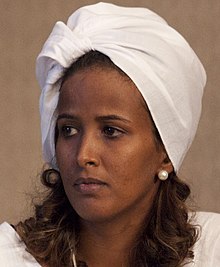
Somali woman with shoulder-length hair.
Throughout much of Africa, afro-textured hair is the almost frequent hair course, except amid the Afro-Asiatic (Hamito-Semitic) speaking populations in North Africa and the Horn of Africa. In the latter regions, naturally long hair is instead more common.[51]
In Due west African cultures, women with long hair were highly valued. Long, thick hair was seen as a sign of wellness, strength, and capability to bear many children. In keeping with this full general theme, women who were too young for marriage would shave a portion of their heads to signal so. This tradition, all the same, did not extend to every W African civilization, as several valued shorter hair.[52]
Asia [edit]
Historically, Due east Asian cultures viewed long hair as a sign of youth and aesthetic dazzler. Long hair is associated with individual life and sexuality. Eastward Asian cultures see long, unkempt hair in a woman equally a sign of sexual intent or a contempo sexual encounter, equally usually their hair is tied up.[fourteen] Lay Buddhists have long pilus, while Buddhist monks have shaved heads.[11]
-

Japanese woman combing her long pilus. (Colour woodblock print from 1920 by Hashiguchi Goyō.)
-
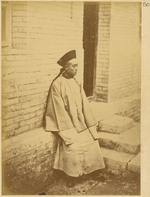
Chinese orthodox Christian man from 1874
-
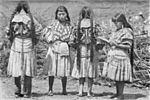
Nosu girls in People's republic of china 1922.
China [edit]
In aboriginal People's republic of china and Korea, pilus was regarded equally a precious legacy from parents. Most people would never cut their hair after they became adults, and cutting off one's hair was a penalty for minor crimes. Both men and women would coil upward their pilus and many hair-coiling styles were developed.
Beginning in 1619, the ethnic Manchu Qing dynasty forced all men in China to adopt the queue: a long braid downwards the back with the pilus near the brow completely shaved. Hair length and style became a life-or-death affair in 1645 every bit the Manchu told them either their pilus or their caput would be cutting. Nearly every Han rebel grouping began past shearing this pigtail (well-nigh especially in the case of the Taiping, who were known in Chinese as the "Longhairs"), merely the queue on penalty of decease lasted until 1911, when the Chinese people cut their queues in unison at a fourth dimension of rebellion. Americans at outset judged Chinese immigrant laborers to be poor workers because their long hair brought an association with women.[53]
Islamic and Christian missionaries among the Chinese were stiff advocates of shorter male hair for their converts.[54] Around the Devastation of Four Olds menses in 1964, well-nigh annihilation seen as function of Traditional Chinese culture would pb to issues with the Communist Reddish Guards. Items that attracted dangerous attention if caught in the public included jewelry and long male person hair.[55] These things were regarded as symbols of bourgeois lifestyle, that represented wealth. People had to avert them or endure serious consequences such as tortures and beatings by the guards.[55] More recently, long pilus was ridiculed in China from October 1983 to December 1983, every bit part of the short and unsuccessful Anti-Spiritual Pollution Campaign.[56]
Also, in Chinese ancient and mod verse, long hair is a common symbol used past poets, for example Li Bai and Li Shangyin, to express their depression and sadness.
Southeast Asia [edit]
In Southeast Asia and Republic of indonesia, male long hair was valued until the 17th century, when the area adopted outside influences including Islam and Christianity. Invading cultures enforced shorter hairstyles on men every bit a sign of servitude, every bit well. They were also confused by the brusque hairstyles amid women in sure areas, such as Thailand, and struggled to explain why women in the area had such short hair. They came upward with several mythical stories, one of which involved a king who found a long hair in his rice and, in a rage, demanded that all women keep their hair short.[54]
In countries like Republic of india, especially rural parts, girls and young women by and large grow their hair very long, often reaching hip-length or thigh length pilus. Long hair in India is considered an essential function of a woman.
Japan [edit]

Japanese woman with long hair
In medieval Japan, heian men were not very interested in a woman'southward concrete dazzler and rarely had an opportunity to run across it. The only concrete attribute of involvement was a woman's pilus, which had to be thick and longer than she was tall.[ citation needed ]
In organized religion [edit]
Judaism [edit]

In the Former Testament, the Nazirites would become for long periods of time without cutting their hair to show devotion to God.[57] Samson is one example; his strength depended upon his refraining from cutting his hair, described equally worn in "vii locks".[12]
Strict Orthodox Judaism forbids men from cutting their sidelocks, but other pilus may be kept as desired. Hair is not cut during a time of mourning. The Torah in Deuteronomy fourteen:ane prohibits removing hair in mourning for the expressionless.
Islam [edit]

In the by, Bedouin Muslims often wore their hair in long braids, but influences from the Western world have caused a alter in attitudes. Bedouins are at present less likely to accept long pilus.[58] Islamic countries in North Africa such as Egypt view long pilus in men as modernist and in i instance the Egyptian police viewed information technology as Satanic and a sign of an infidel.[59] Castilian rulers during the Medieval Period suspected long-haired males to be Moors or Moriscos, therefore long hair was forbidden since it was believed to be a Moorish custom. However, modern North African men have adopted Western short hair.
Muslims regard the Prophet Muhammad every bit the all-time example to live by, and try to emulate him whenever possible. The Islamic Prophet Muhammad reportedly in Sahih Muslim had hair that "hung over his shoulders and earlobes".[60] Sahih Bukhari, regarded the most authentic of hadith, as well supports this using a prime example of the prophet Isa (Jesus).[61] The Prophet Muhammad has too described Jesus equally "having long pilus reaching his ear lobes."[62] Malik's Muwatta 51.2.6 reported, Yahya related to me from Malik from Yahya ibn Said that Abu Qatada al-Ansari said to the Messenger of Allah, may Allah anoint him and grant him peace, "I have a lot of hair which comes down to my shoulders, shall I comb it? The Messenger of Allah, may Allah bless him and grant him peace, said, "Yes, and honour it." Sometimes Abu Qatada oiled it twice in ane day because the Messenger of Allah, may Allah bless him and grant him peace, said to him. "Award it."
With regards to women, neither Qur'an nor Sunnah explicitly state that women cannot cutting their pilus. Hadith does mention that women should not imitate men, and vice versa, and hence many scholars on this assumption, decree that women should let their pilus grow longer than the pilus of the Prophet, reaching beyond their shoulders, equally hadith mentions that the Prophet had his hair betwixt his shoulder and his earlobes. (He described Jesus's hair, which hung to his earlobes, equally long.[63])
All the same, co-ordinate to some hadiths regarding the rules of awrah, women are required to grow hair long, long plenty that it would cover the breasts or as much awrah parts of the body when they're being buried, considering she lacks clothes and long pilus would be used as a covering instead.
Some Muslims are too opposed to men having long hair equally information technology is as well important in Islam to have clear differences (in advent) betwixt sexes. By and large these cultures encourage women to accept long pilus and men to have brusk hair.[64] The Taliban in Afghanistan viewed long hair for men every bit a Western influence, and punished information technology past arrest and forced haircuts,[65] although this would be a direct contradiction of the sunnah of the Prophet. Similar measures have been taken by Islamists in Republic of iraq.[66] In spite of this, several Taliban affiliated members of the Mehsud clan are recognisable by their long hair.[67] [68] The Saudi Islamist fighter Amir Khattab was as well notable for his long pilus. Dervishes of some Sufi orders, such as the Kasnazani, often have long pilus and whirl it effectually during rituals.[69]
Sikhism [edit]
For Sikhs, Kesh is the exercise of allowing one'southward pilus to grow naturally as a symbol of devotion to God and lack of worldliness.[13]
Encounter likewise [edit]
- Training
- Haircut
- Hair extensions
- Hair stick
- Lady Godiva
- Long hair fetishism, a grade of Trichophilia
- Rapunzel
- Bristles and haircut laws by land
- Let'due south trim our hair in accordance with the socialist lifestyle
- Long pilus in Singapore
Images [edit]
- Female person long pilus in art (Gallery at Wikimedia commons)
- Female long pilus photos (Gallery at Wikimedia commons)
- Male long hair in art (Gallery at Wikimedia commons)
- Male long pilus photos (Gallery at Wikimedia commons)
References [edit]
- ^ Buss, David 1000. (2005). The handbook of evolutionary psychology. John Wiley and Sons. p. 309. ISBN978-0-471-26403-three.
- ^ Bereczkei, T. (2007). "Pilus length, facial attractiveness, personality attribution; A multiple fitness model of hairdressing". Review of Psychology. xiii (one): 35–42.
- ^ Scorolli, C; Ghirlanda, S; Enquist, G; Zattoni, S; Jannini, E A (2007). "Relative prevalence of different fetishes". International Journal of Impotence Research. 19 (4): 432–7. doi:x.1038/sj.ijir.3901547. PMID 17304204.
- ^ "Heels meridian the global fetish leader lath". England. Archived from the original on fourteen July 2014. Retrieved 9 July 2014.
- ^ "2.2 Applications and skills". www.philpoteducation.com . Retrieved 7 Nov 2019.
- ^ "Figure 5. The office of ARA in bone development and homeostatic".
- ^ a b Watson, James (2005). Darwin: the Enduring Postage stamp; the Development of an Idea. Philadelphia: Running Press. p. 1042. ISBN0-7624-2136-3.
- ^ a b Hinsz, Verlin B.; Matz, David C.; Patience, Rebecca A. (2001). "Does women's pilus bespeak reproductive potential?". Periodical of Experimental Social Psychology. 37 (two): 166. doi:10.1006/jesp.2000.1450.
- ^ Sugiyama, Lawrence S. (2005) "Concrete Attractiveness in Adaptationist Perspective", Chapter ten in Buss, David M. (ed.) The Handbook of Evolutionary Psychology. John Wiley & Sons, Inc. ISBN 978-0-471-26403-3
- ^ Williams, Simon Johnson; Birke, Lynda I. A.; Bendelow, Gillian (2003). Debating biology: sociological reflections on health, medicine, and society. Routledge. p. 130. ISBN0-415-27903-viii.
- ^ a b c Leach, Eastward. R. (July 1958). "Magical Hair". Periodical of the Royal Anthropological Institute. 88 (2): 147–164. doi:ten.2307/2844249. JSTOR 2844249.
- ^ a b Judges thirteen–16
- ^ a b Fowler, Jeaneane (1997). Globe Religions: an Introduction for Students. Brighton: Sussex Academic Press. p. 352. ISBN1-898723-48-vi.
- ^ a b c Maynard, Margaret (2004), Dress and Globalisation, Manchester: Manchester University Printing, p. 104, ISBN0-7190-6389-2
- ^ a b Oxford English Lexicon
- ^ a b c Clarence Robbins and Marjorie Gene Robbins, "Scalp hair length. 2. Estimating the percentages of adults in the United states and larger populations by hari length." Archived 17 December 2014 at the Wayback Auto Periodical of corrective science 54.4 (2003): 367–378.
- ^ a b c d due east Gonzalez, Anthony (2007). Cosmetology. Global Media. p. 54. ISBN978-81-89940-45-four.
- ^ a b Hemat, R. A. Due south. (2007). Andropathy. Urotext. p. 375. ISBN978-i-903737-08-8.
- ^ Robbins, Clarence R. (2002). Chemical and physical behavior of homo pilus. Springer. ISBN0-387-95094-X.
- ^ Guinness Globe Records: Longest hair. guinnessworldrecords.com
- ^ Tortora & Derrickson (2012). Principles of Anatomy & Physiology (thirteen ed.). John Wiley & Sons, Inc. p. 163.
- ^ Maeda, T.; Yamamoto, T.; Isikawa, Y.; Itoh, N.; Arase, Due south. (2007). "Sanguisorba Officinalis Root Excerpt Has FGF-5 Inhibitory Activity and Reduces Hair Loss by Causing Prolongation of the Anagen Period". Nishi Nippon Hifuka. 69: 81–86. doi:10.2336/nishinihonhifu.69.81.
- ^ Irwin, M. Eleanor (Oct 1990). "Odysseus' "Hyacinthine Pilus" in 'Odyssey' six.231". Phoenix. 44 (3): 205–218. doi:ten.2307/1088933. JSTOR 1088933.
- ^ a b Nicolson, Frank W. (1891). "Greek and Roman Barbers". Harvard Studies in Classical Philology. 2: 41–56. doi:10.2307/310326. JSTOR 310326.
- ^ Pliny the Elder at Perseus
- ^ Bartman, Elizabeth (Jan 2001). "Hair and the Artifice of Roman Female Beautification". American Journal of Archaeology. 105 (1): 1–25. doi:10.2307/507324. JSTOR 507324.
- ^ Felt, Joseph (1967). Customs of New England. New York: Burt Franklin. p. 187. ISBN0-8337-1105-9.
- ^ Connolly, Sean J (2007). "Prologue". Contested island: Ireland 1460–1630 . Oxford University Press. p. 7. ISBN978-0-xix-820816-7.
- ^ The Brehon Laws: A Legal Handbook: Chapter VII, Laurence Ginnell (1894)
- ^ Bartlett, Robert (1994). "Symbolic Meanings of Hair in the Middle Ages". Transactions of the Royal Historical Social club. Sixth series. 4: 43–60. doi:10.2307/3679214. JSTOR 3679214.
- ^ McManus, Howard Rollins (1989). The Battle of Cloids Mountain of Virginia, 1864. University of Michigan. p. 35.
- ^ Whicker, Alan. This evening: "Beatniks in Newquay". BBC, 1960.
- ^ a b Bronski, Michael (2000), The Pleasure Principle: Sexual practice, Backlash, and the Struggle for Gay Freedom, Stonewall Inn Editions, pp. 95–96, ISBN0-312-25287-0
- ^ Gossai, Hemchand; Murrell, Nathaniel, Religion, Civilisation, and Tradition in the Caribbean
- ^ Lu, Hsiao-Peng (1997), Transnational Chinese Cinemas, Honolulu: Academy of Hawaii Press, p. 229, ISBN0-8248-1845-8
- ^ Weinstein, Deena (2000), Heavy Metal, New York: Da Capo Press, p. 129, ISBN0-306-80970-two
- ^ Kirk, Lowell (1999). "Cherokee Myths and Legends". Retrieved 9 September 2007.
- ^ Ferris, Jeri (1991), Native American Physician, Minneapolis: Carolrhoda Books, pp. 32–33, ISBN0-87614-443-1
- ^ Kilcup, Karen (2000), Native American Women's Writing, C. 1800–1924, Cambridge: Blackwell Publishers, pp. 314–316, ISBN0-631-20518-7
- ^ Cavallo, Dominick (1999), A Fiction of the past, New York: St. Martin'southward Press, p. 90, ISBN0-312-23501-one
- ^ Nagel, Joane (1997), American Indian Ethnic Renewal, Oxford Oxfordshire: Oxford University Press, p. 191, ISBN0-xix-512063-9
- ^ French, Laurence (2003), Native American Justice, Lanham: Rowman & Littlefield Publishers, Inc, pp. 113–117, ISBN0-8304-1575-0
- ^ Fontana, Vincent (2003), Municipal Liability, Aspen Law & Business Publishers, pp. 241–242, ISBN0-7355-1375-9
- ^ Byrd, pp. 25–49
- ^ Synnott, Anthony (September 1987). "Shame and Celebrity: A Sociology of Pilus". The British Journal of Sociology. 38 (3): 381–413. doi:10.2307/590695. JSTOR 590695.
- ^ Taylor, Paul C. (1999). "Malcolm's Conk and Danto's Colors; Or, Iv Logical Petitions apropos Race, Beauty, and Aesthetics". The Periodical of Aesthetics and Art Criticism. 57 (1): 16–20. doi:10.2307/432060. JSTOR 432060.
- ^ Jones, Amelia (2003). The Feminism and Visual Culture Reader. New York: Routledge. p. 343. ISBN 0415267056
- ^ a b Robbins; Robbins, Thou. Yard. (2003). "Scalp hair length. I. Hair length in Florida theme parks: An approximation of hair length in the United States of America". Journal of Cosmetic Science. 54 (1): 53–62. PMID 12644859.
- ^ "On Being a Longhair". choisser.com . Retrieved 26 September 2020.
- ^ "Us Census Bureau QuickFacts". census.gov . Retrieved 26 September 2020.
- ^ Hiernaux, Jean (1975). The People of Africa. Scribners. p. 59. ISBN0684140403.
- ^ Byrd, pp. 2–5
- ^ Prasso, Sheridan (2005), The Asian Mystique, New York: Public Affairs Press, pp. 115–116, ISBNane-58648-214-nine
- ^ a b Reid, Anthony (1988). Southeast Asia in the Age of Commerce, 1450–1680. New Haven: Yale University Press. p. 82. ISBN0-300-04750-9.
- ^ a b Law, Kam-yee (2003), The Chinese Cultural Revolution Reconsidered: beyond purge and Holocaust, Palgrave Macmillan, ISBN0-333-73835-7
- ^ "Olympic crackdown on Mainland china'due south bad habits". BBC News. 6 August 2007. Retrieved 9 September 2007.
- ^ Numbers six:5, Numbers 6:18–19
- ^ Massad, Joseph (2001), Colonial Effects, New York: Columbia University Printing, pp. 137–140, 208–210, ISBN0-231-12322-1
- ^ Heper, Metin (1998), Ismet Inonu: the Making of a Turkish Statesman, Boston: Brill Academic Publishers, p. 153, ISBN90-04-09919-0
- ^ Sahih Muslim Book 30 Number 5773: "Qatada reported: I asked Anas b. Malik: How was the pilus of Allah's Messenger? Thereupon he said: His pilus was neither very curly nor very straight, and they hung over his shoulders and earlobes."
- ^ Sahih Al-Bukhari Volume 7 Book 72 Number 788: "Narrated Al-Bara': I did not see anybody in a blood-red cloak looking more than handsome than the Prophet Narrated Malik: The pilus of the Prophet used to hang near his shoulders. Narrated Shu'ba: The pilus of the Prophet used to hang downward to the earlobes."
- ^ Sahih Al-Bukhari Volume ix Volume 87 Number 128 : Narrated 'Abdullah bin 'Umar: Allah's Apostle said, "I saw myself (in a dream) nigh the Ka'ba last night, and I saw a human with whitish cerise complexion, the best you may come across amongst men of that complexion having long hair reaching his earlobes which was the all-time pilus of its sort, and he had combed his pilus and h2o was dropping from it, and he was performing the Tawaf around the Ka'ba while he was leaning on two men or on the shoulders of two men. I asked, 'Who is this homo?' Somebody replied, '(He is) Messiah, son of Mary.' Then I saw another human with very curly pilus, blind in the right eye which looked like a protruding out grape. I asked, 'Who is this?' Somebody replied, '(He is) Messiah, Advertisement-Dajjal.'"
- ^ Sahih Al-Bukhari Volume nine Book 87 Number 128
- ^ Joseph, Suad; Najmabadi, Afsaneh (2005), Encyclopedia of Women & Islamic Cultures: Family unit, Body, Sexuality and Health, Volume three, Boston: Brill Bookish Publishers, p. 35, ISBNxc-04-12819-0
- ^ Rashid, Ahmed (2002), Taliban: Islam, oil and the new great game in key Asia, I B Tauris & Co Ltd, p. 219, ISBN1-86064-830-four
- ^ Raghavan, Sudarsan (6 October 2006), "Another freedom cut brusk: Republic of iraq's barbers nether threat", The Washington Postal service, archived from the original on 25 July 2008, retrieved 19 May 2009
- ^ "South Asia | Profile: Abdullah Mehsud". BBC News. 24 July 2007. Retrieved 27 October 2013.
- ^ "Taliban leader Hakimullah Mehsud threatens US months after 'death'". The Daily Telegraph. three May 2010. Retrieved 27 October 2013.
- ^ Wong, Edward (22 August 2005). "Iraq's Sufis attacked as strife widens". The New York Times.
Bibliography [edit]
- Byrd, Ayana; Tharps, Lori (2002). Hair Story. New York: St. Martin's Griffin. ISBN0-312-28322-9.
0 Response to "Good Long Hair Fashions for Waitresses"
Post a Comment